
Following is an excerpt of Dr. Dinesh Chauhan being interviewed by Dr. Manish Bhatia at the ‘Hpathy Hotseat
If this sounds familiar, you are far from alone. This is the exact loop that thousands of homeopaths and students across the world find themselves stuck in. Beyond the massive polycrests or broad family patterns, remembering the vast landscape of thousands of remedies feels like an impossible task.
For over 25 years, Dinesh Chauhan’s focus as a practitioner and teacher has been on the case witnessing process—how to sit with a patient, stay out of the way, and allow their core pattern to reveal itself. But let’s be honest: case witnessing is only one side of the coin. If you don’t master your Materia Medica, what are you going to do with that beautifully witnessed case? You cannot build clinical success on a witnessed case if you can’t bridge it to the correct remedy.
So, why is Materia Medica so notoriously difficult to remember? The answer lies in how we are taught to study it.
The Trap of One-Dimensional Homeopathy
The fundamental issue is what I call one-dimensional homeopathy. Statistically, about 95% of us study our remedies through a single lens at any given time. We become deeply anchored to:
-
One Book / One Master: We approach a remedy purely from a Kentian, Boger, Phatak, or Clark perspective.
-
One Specific Methodology: We rely solely on keynotes (like Allen), themes (like Vitoulkas or Massimo), or the sensation method (like Sankaran).
-
A Single System Focus: We read clinical patterns from literature written 150 to 200 years ago without integrating external scientific evolutions.
When you study a remedy from just one book or system, you are essentially looking at a single line of data. Your brain tries to use rote memorization to hold onto facts. But human memory does not preserve isolated lists of rubrics and symptoms for very long. To truly retain a remedy, you have to stop memorizing it and start understanding it from an inclusive, integrative, and multidimensional perspective.
Phase 1: The Inclusive Holistic Module (Inside Homeopathy)
Before we can look outside of homeopathy, we first need to maximize how we look within our own literature. Instead of letting a single master dictate a remedy’s portrait, we can divide classical and contemporary homeopathic literature into seven distinct types of books:
-
Kentian Type: Focused heavily on the mental landscape, physical generalities, and fine particulars.
-
Boger/Böenninghausen Type: Prioritizing physical generals, mental generals, modalities, and the specific sphere of action.
-
Keynote Type: Capturing the high-grade, defining characteristics of a remedy (e.g., Allen’s Keynotes).
-
Thematic Type: Looking at the overarching psychological or structural themes of a remedy.
-
Contemporary Type: Incorporating insights from modern masters who have expanded on classical foundations.
-
Proving Type: Going back to the raw, unedited symptoms recorded during old and modern provings.
-
Repertory Type: Tracking how the remedy is structurally represented across various rubrics.
Finding the “Holistic Thread”
When you analyze a remedy, pull one reference from each of these categories. Look closely at where they intersect. What symptom, modality, or sensation is constant across three or more of these completely different styles of books?
When you discover that specific thread running through and through—from the mental sphere down to the local physical particulars—you unlock a master key. The remedy is no longer a collection of bullet points; it becomes a coherent, living entity in your mind.
Phase 2: Shifting to a Multidimensional Framework (Outside Homeopathy)
Even if you use all seven types of homeopathic books, you are still operating within a closed loop. If the original literature contained a collective blind spot or a confirmatory bias about a remedy, you inherit it.
To build an unforgettable, bulletproof understanding, we must take a paradigm shift and look at the substance across seven different external dimensions:
1. Exact Biological & Natural Classification
We must understand precisely where a remedy sits in nature. For instance, Arnica and Echinacea might look entirely different in their clinical presentations, but they belong to the exact same Asteraceae (Composite) family. Cina and Absinthium belong to the exact same genus. When you understand the baseline classification of the 172+ remedies within a family, you stop treating every single remedy as an isolated island.
2. Natural Characteristics of the Substance
How does the substance behave in the wild? What are its physical properties, its survival mechanisms, and its unique traits? The raw nature of the plant, mineral, or animal always mirrors the dynamic expression found in its homeopathic proving.
3. Chemical Profiling & Modern Research
Science has evolved dramatically over the last 50 years. We now know the exact chemical constituents of the substances we use. Look at modern pharmacological papers.
Take Arnica, for example. Homeopaths universally think of it as an acute remedy for trauma and bruising. However, if you look at modern peer-reviewed scientific papers on Arnica’s chemical compounds, the vast majority focus on its power against chronic inflammation and cancer. If you go back to the deepest center of our Materia Medica with this knowledge, you suddenly realize that the Arnica pattern has an underlying connection to the cancer miasm that we routinely miss due to our own confirmatory bias.
4. Complementary & Alternative Medicine (CAM)
What do other healing sciences say about this substance? Many of our classical remedies were originally adopted from the historic Eclectic school of medicine. By checking how a substance is used in Bach Flower essences, herbalism, or traditional medicine systems, you gain an incredibly rich context that perfectly complements your homeopathic understanding.
5. History and Mythology
The historical and mythological stories surrounding a substance carry deep symbolic truths about its energetic pattern. For example, in modern homeopathy, we often think of Podophyllum through the clinical shorthand of the “7 Ps” (primarily centered around gastrointestinal distress and profuse diarrhea). But if you look into history and mythology, Podophyllum was intrinsically utilized to treat abnormal growths long before our modern definitions of cancer existed. Mythology provides the psychological archetype of a remedy, making it stick in your memory far better than an isolated list of symptoms.
Stop Memorizing, Start Witnessing the Remedy
When you build a bridge between the internal homeopathic literature (Kentian, Boger, Keynotes) and the external dimensions (biology, chemistry, history, mythology), something incredible happens. You no longer have to struggle to memorize data points.
The remedy stops being a flat page in a book and becomes a three-dimensional character. You understand its chemistry, you know its family lineage, you recognize its historical archetype, and you see its holistic thread.
The next time a patient walks into your clinic and exhibits that specific pattern, you won’t have to strain your memory to recall a rubric. You will simply recognize the remedy standing right in front of you.

Dear Team
I would like to know whether this multidimensional course only talks about remedies from the Plant Kingdom or also from the Mineral Kingdom and the most important Nosodes? (so that it becomes even more multidimensional. ) Or would that be subject for another course, some time in the future?
Kind regards
Angelique Royers
8718 Schänis
Switzerland
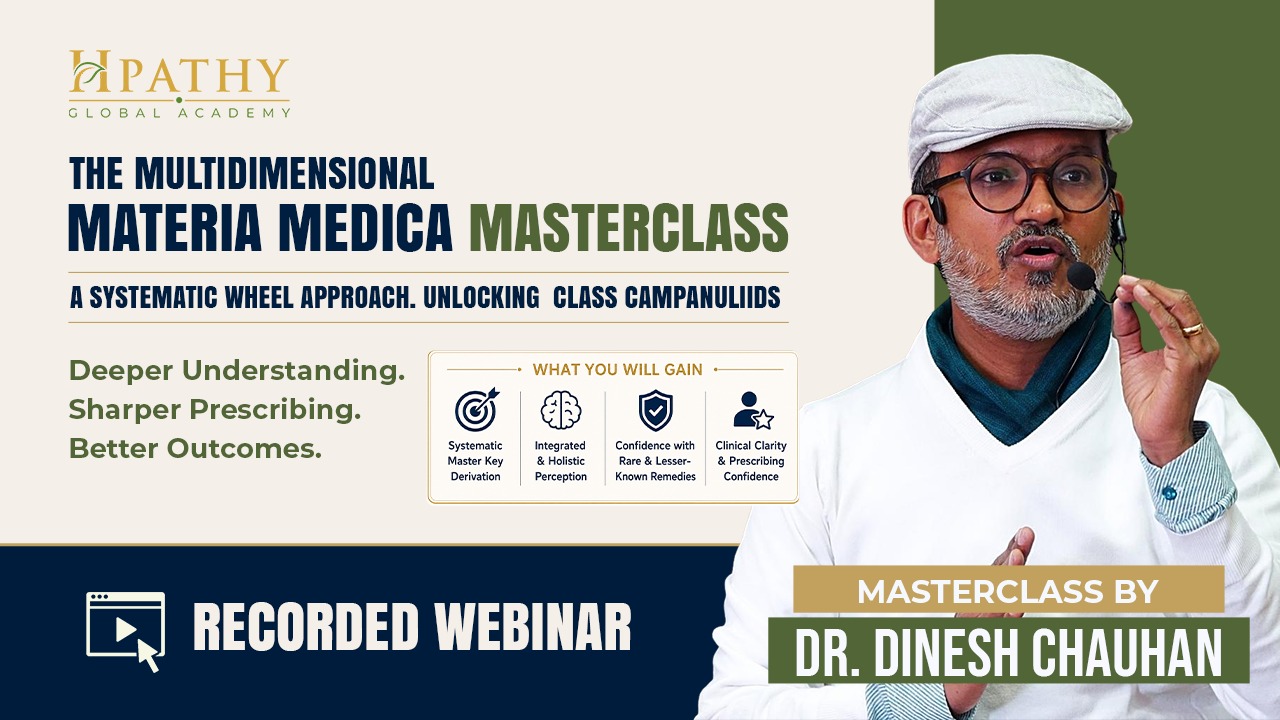
This particular course focuses on Plant remedies, esp focusing on the class Campanulids and its families like Compositae. You can find the course on mineral kingdom by David Johnson here at the academy website. A nosode course will come in future.
Thank you.
Hello,
Will this course allow questions interrupting the teacher during each class session (I find that very difficult )
Or will the questions be at the end of each class?