
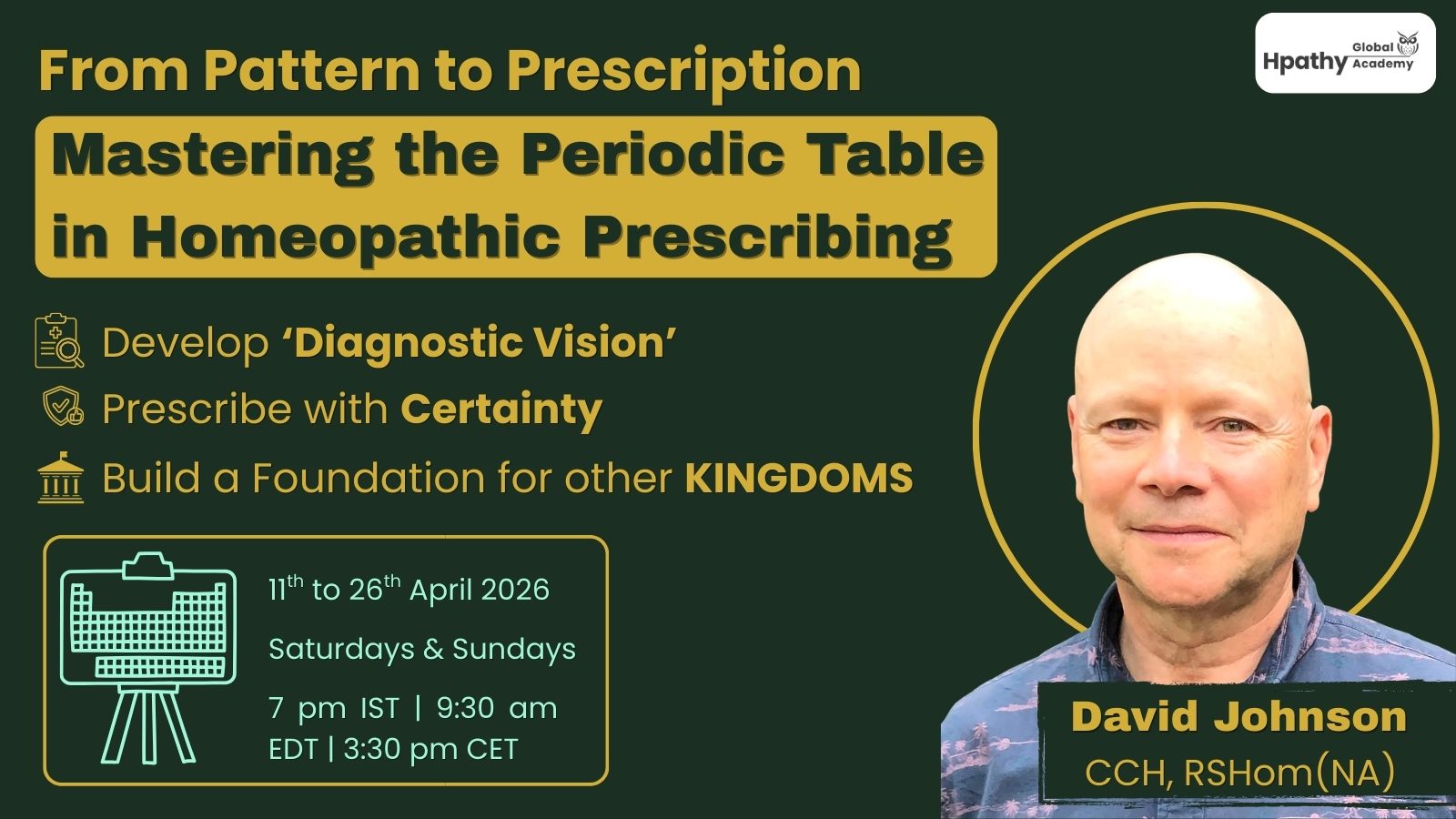
From Pattern to Prescription – Mastering the Periodic Table in Homeopathic Prescribing
About Course
Mastering the Periodic Table in Homeopathic Prescribing
From Pattern to Prescription
A Live Masterclass with David Johnson
Learn how to interpret a patient’s life story through the structure of the periodic table — and confidently prescribe the correct mineral remedy.
📅 April 11 – April 26, 2026
🎓 6 Live Sessions
🎥 2 Year Recording Access
Instructor: David Johnson, CCH, RSHom(NA)
Includes: Live Q&A + 2-year recordings + certificate
Best for: Practicing homeopaths & advanced students
Early Bird: $180 (ends March 21) → Regular $299
Indian pricing: Available in INR at checkout
Why This Course Matters
Most homeopaths rely heavily on a familiar group of polychrest remedies. But sooner or later, every practitioner encounters cases that do not fit any known remedy picture.
The patient’s symptoms feel structured and meaningful, yet the remedy remains elusive. Many such cases belong to the mineral kingdom.
And the key to understanding them lies in the periodic table of elements.
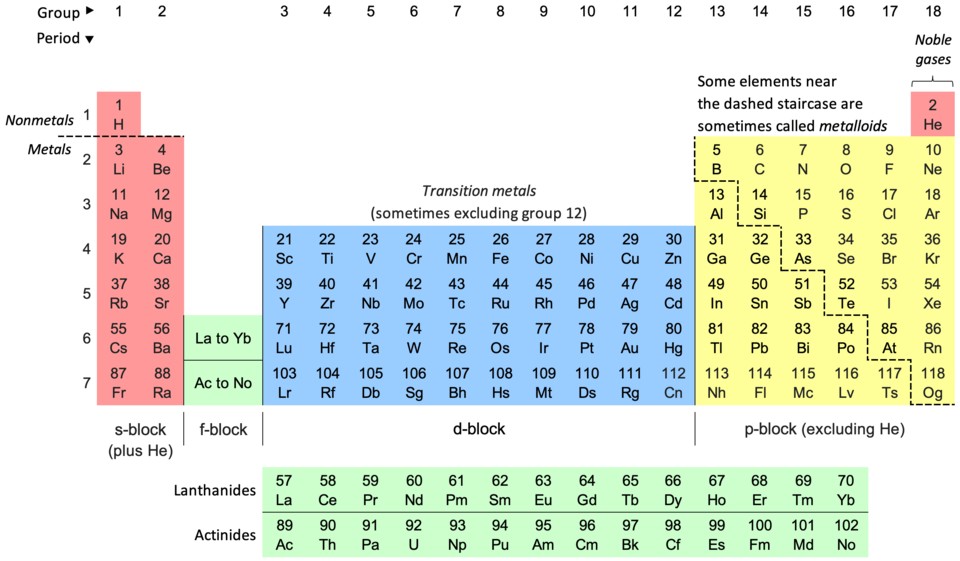
The periodic table is not merely a list of substances — it is a map of human experience.
Each series reflects a stage of life.
Each column represents a developmental struggle.
When you learn to read this map, prescribing mineral remedies becomes dramatically clearer.
Instead of guessing between remedies, you begin to recognize patterns that point directly to the correct element.
This course will teach you exactly how to do that.
The Power of the Periodic Table Approach
Developed and expanded by Jan Scholten, the periodic table approach reveals a deep and elegant structure within the mineral kingdom. When properly understood, it allows practitioners to:
✔ Recognize the series and stage of a case
✔ Identify precise mineral remedies, including lesser-known salts
✔ Understand complex patient narratives through structural patterns
✔ Prescribe remedies beyond the traditional polychrests
✔ Gain deeper insight into difficult chronic cases
For many practitioners, this approach becomes a turning point in their clinical development.
What You Will Learn
By the end of this masterclass, you will be able to:
Recognize the Structure of Mineral Cases
Understand how life themes correspond to series within the periodic table.
Identify the Stage of Development – Learn how columns represent progression, struggle, achievement, and decline.
Translate Patient Narratives into Remedies – Develop the ability to hear a patient’s story and recognize which element it corresponds to.
Prescribe Lesser-Known Mineral Remedies – Move beyond commonly used remedies and prescribe accurate mineral salts with confidence.
Understand the Lanthanides and Actinides – Gain clarity on these fascinating remedy groups and their clinical applications.
Integrate Periodic Table Thinking into Everyday Practice – Learn how to combine traditional materia medica with structural analysis.
What Changes After You Learn This
After this masterclass, you won’t be stuck thinking:
“Mineral case… but which one?”
Instead, you’ll be able to:
-
Identify the Series (life theme) and Stage (developmental position) from the patient’s narrative
-
Choose between “similar sounding” remedies (e.g., Natrum vs Magnesia vs Alumina) with greater clarity
-
Use cation + anion themes to build a precise prescription even when repertorization is unclear
-
Recognize when the periodic table approach is the right tool—and when another kingdom is more appropriate
. 
.
Meet Your Teacher
David Johnson, CCH, RSHom(NA)
 David Johnson is an internationally respected homeopath and educator with decades of clinical experience.
He has taught extensively on the periodic table approach, helping practitioners understand how mineral remedies reflect deeper patterns in human development.
David is known for his ability to translate complex theoretical concepts into clear, clinically usable insights. In this masterclass, he will guide participants step-by-step through the logic and application of the periodic table in real practice.
Course Curriculum
Session 1: Periodic Table – The “Big Picture”
April 11th
- Organization and progression of elements from Hahnemann’s time to the present
- The relevance and purpose of two and three dimensional tables for homeopaths: Standard Table; Spiral Table; Descending Spiral
- “Synthetic” prescribing with matching cation and anion themes: how to do it with confidence, even if the compound does not come up high in repertorization.
- Overview of the Periodic Table Schema:
- Left vs. right side and top vs bottom themes in the table
- 7 Series/Horizontal Rows (left vs. right)
- 18 Stages/Vertical Columns (top vs. bottom)
- General themes of the first 3 Series respectively
- Specific themes of human development reflected by the progression of elements in the first 3 Series
By the end of this session students should be able to:
1) Recognize the ways in which different periodic table formats are helpful to homeopaths
2) Distinguish and define the themes of the first 3 Series (horizontal rows) of elements, and how they differ from the themes of the following 4 Series.
3) Recognize the specific sequence of elements in the first 3 Series and how they are matched with progressive developmental experiences and challenges
Session 2: The First 18 elements
April 12th Brief review
- Distinguishing between similar looking elements in the first 3 Series:
- 1st: Hydrogen and Helium;
- 2nd: Lithium, Beryllium, Boron, Carbon; Nitrogen, Oxygen, Fluoride and Neon;
- 3rd: Natrum, Magnesium, Alumina, Silica, Phosphorus, Sulphur, Muriaticum and Argon
- Distinguish between similar looking energies of the eleven most commonly used anions:
- Alphabetically: Arsenicum, bromatum, carbonicum, fluoratum, iodatum, muriaticum, nitricum, oxydatum, phosphoricum, silicata and sulphuricum
- Increasing Atomic Weight: Carbonicum, nitricum, oxydatum, fluoratum, silicata, phosphoricum, sulphuricum, muriaticum, arsenicum, bromatum, iodatum
By the end of this session students should be able to:
- Distinguish between similar looking elements in the first 3 Series.
- Distinguish between similar looking elements commonly used as anions.
Session 3:
April 18th
- Review of the respective themes of Series 1-3, and the difference between Series 1-3 and Series 4 through 7
- Distinguishing between Series 4 through 7
- Themes of the 18 Stages
- Distinguishing between Stages 1 through 18/0
- Respective themes according to an element’s position within the table, i.e., by the intersection of the element’s respective Series and Stage
By the end of this session students should be able to:
Predict an element’s general indications for use according to the themes of the periodic table Series (horizontal rows) and Stages (vertical elements.)
Alternately, given a history with themes of a specific Series and Stage, predict what element or elemental salt matches those themes.
Session 4: Lanthanides and Actinides
April 19th Introduction to Lanthanides and Actinides
By the end of this session students should be able to:
- Identify the ways in which a Lanthanide history is expressed, both in terms of language as well as physical issues
- Identify the ways in which an Actinide history is expressed, both in terms of language as well as physical issues.
- Given a history with themes of a specific Lanthanide or Actinide Series, predict what element or elemental salt matches those themes.
Session 5:
April 25th Exploration of histories relating to the entire table, including Lanthanides and Actinides
By the end of this session students should be able to:
Distinguish Series, Stages, and anion themes within a history and match those with a specific element or elemental salt (cation and anion) using the entire table.
Session 6:
April 26th
Review of the principles covered in the first 5 sessions; understanding the table as a whole and its different patterns of remedy energies. What types of historical themes are best matched with the periodic table elements? What are the table’s strengths and weaknesses, that is, with what histories can it be best used, and when do we turn to other kingdoms?
By the end of this session students should be able to:
Recognize specific themes within a history and consider the entire table as a resource to confidently zero in on matching elements or elemental salt remedies. Concluding Questions and Answers
Who This Course Is For
This course is ideal for:
✔ Practicing homeopaths
✔ Advanced homeopathy students
✔ Practitioners interested in mineral remedies
✔ Anyone wanting a deeper structural understanding of materia medica Basic knowledge of homeopathy is recommended.
What Makes This Course Unique
Unlike many introductory teachings on the periodic table, this masterclass focuses on practical clinical application. You will learn how to:
- Translate patient narratives into periodic table patterns
- Identify remedies through series and stage analysis
- Recognize rare mineral remedies in practice
- Integrate structural understanding with classical homeopathy
The goal is not merely theoretical knowledge, but greater prescribing accuracy in real cases.
Course Format
✔ 6 Live Online Sessions
✔ Interactive Q&A with the teacher
✔ 2-years access to recordings
✔ Certificate of participation
Course Dates
📅 April 11 – April 26, 2026 6 sessions spread across three weekends.
Recordings will be available for those unable to attend live.
Investment
Early Bird Price $180
Regular Price $299
(special prices are available to Indian students in INR)
Early bird discount available for a limited time.
Seats are limited to ensure meaningful interaction during the live sessions.
If you have been curious about the periodic table approach but never fully understood how to apply it in practice, this course will give you the clarity you need.
Join us and learn how to move from pattern to prescription.
Frequently Asked Questions
Do I need prior knowledge of the periodic table approach?
No. The course will start with the fundamentals and gradually move into deeper clinical applications.
Will recordings be available?
Yes. All sessions will be recorded and available for 2 years.
Can students join?
Yes. Advanced students of homeopathy are welcome.
What is your refund policy?
If you attend the first session and feel the course isn’t right for you, email us within 3 days for a full refund. No refunds possible after 2nd session.
Final Thought
Many homeopaths sense that the periodic table contains a deeper organizing principle within materia medica. But without proper guidance, it can feel abstract and difficult to apply.
This masterclass will help you see the periodic table not as theory, but as a practical tool for prescribing. We look forward to welcoming you to the course.
Testimonials / Feedback
“Dave Johnson’s understanding of the periodic table as it relates to human behavior is astounding. His work has brought great healing into our world.“
— MM, Homeopath; Graduate NAH
“I love Dave’s thoughtful, poignant lectures. His depth and insights are always inspiring and rich… 10/10!“
— RK, Student Homeopath
Course Content
Periodic Table: The Big Picture
The First 18 Elements
Themes of Series
Introduction to Lanthanides and Actinides
Exploration of histories relating to the entire table, including Lanthanides and Actinides
Review of the principles covered in the first 5 sessions
Earn a certificate
Add this certificate to your resume to demonstrate your skills & increase your chances of getting noticed.
Student Ratings & Reviews