
About Course
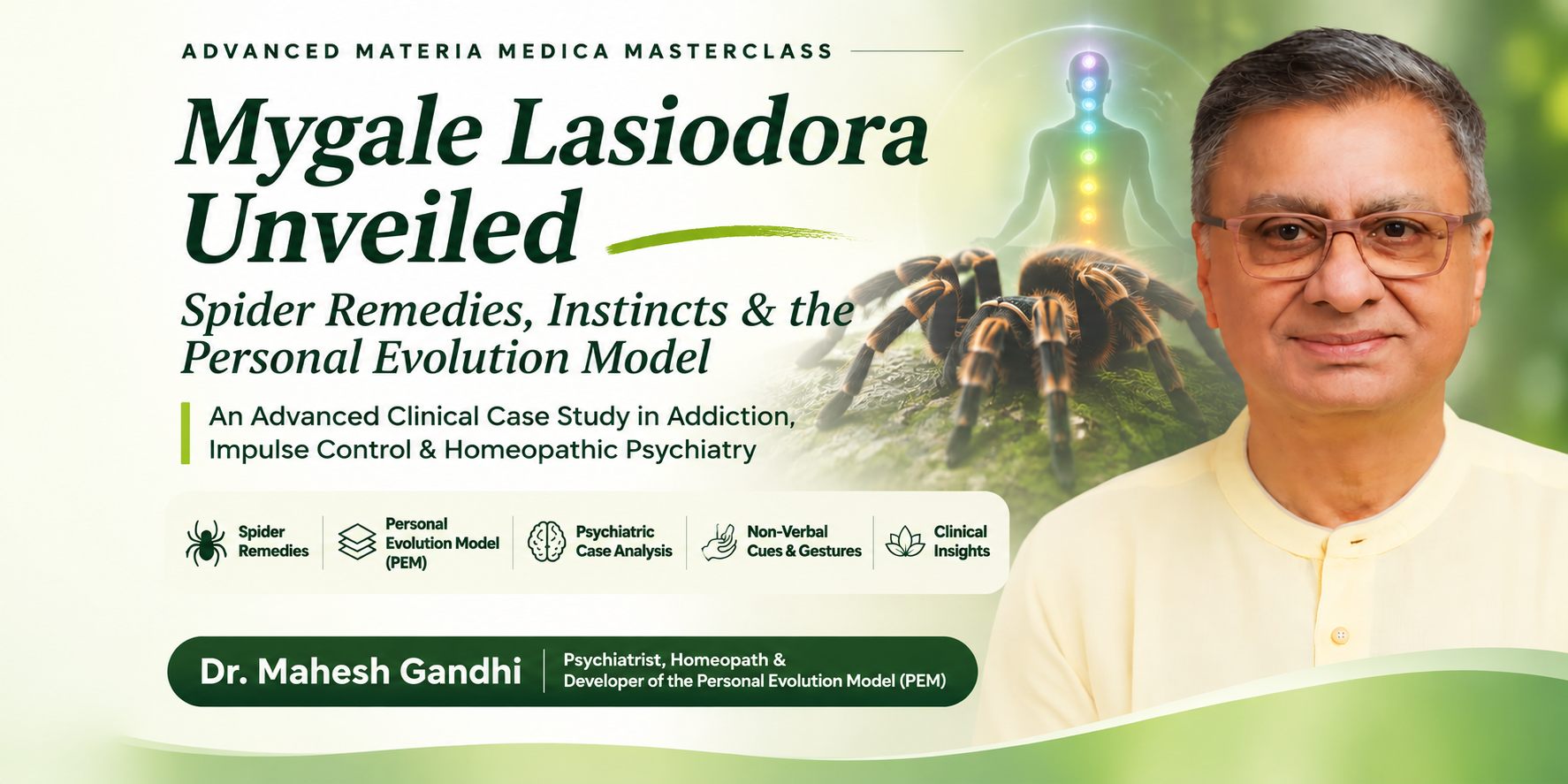
Explore the Hidden World of Spider Remedies Through a Complex Psychiatric Case and Dr. Mahesh Gandhi’s Personal Evolution Model
Instructor: Dr. Mahesh Gandhi
Psychiatrist, Homeopath & Developer of the Personal Evolution Model (PEM)
Course Format: Special Pre-Recorded Clinical Masterclass. Two-Years Access.
Course Focus: Mygale lasiodora | Spider Remedy Themes | Personal Evolution Model | Psychiatric Case Analysis | Non-Verbal Cues & Gestures
When the Patient’s Words Are Not Enough, What Else Should We Observe?
What can involuntary movements, unusual gestures, intense impulses, and recurring behavioral patterns reveal about a patient’s inner experience?
Some clinical cases challenge even experienced homeopaths.
The patient may present with a complex combination of addiction, aggression, emotional instability, compulsive behaviors, and physical symptoms that seem difficult to connect.
Traditional repertorization may produce numerous possibilities without revealing a clear pattern.
How does an experienced homeopath approach such a case?
In this fascinating recorded masterclass, Dr. Mahesh Gandhi presents a complex psychiatric case involving severe cannabis dependence, emotional volatility, uncontrolled impulses, and characteristic motor movements.
Using his Personal Evolution Model (PEM), Dr. Gandhi demonstrates how he interprets the patient’s developmental themes, instinctual responses, gestures, and behavioral patterns to arrive at the homeopathic remedy Mygale lasiodora.
The lecture offers an opportunity to explore the world of spider remedies while following the clinical reasoning of a psychiatrist and homeopath known for his distinctive approach to case analysis.
Go beyond the spoken symptoms. Explore the gestures, instincts, and behavioral patterns that shape Dr. Gandhi’s interpretation of the case.
What You Will Learn
1. Explore the Fascinating World of Spider Remedies
Spider remedies occupy a distinctive place within contemporary homeopathic Materia Medica.
Dr. Gandhi explores the themes and characteristics he associates with the spider group, including:
-
Intense instinctual drives and impulsive behavior.
-
Rapid, restless, or jerky movements.
-
Heightened reactivity and emotional volatility.
-
Themes of aggression, control, transgression, and survival.
-
Characteristic gestures and physical expressions.
-
The relationship between animal behavior and symbolic remedy themes within homeopathic theory.
Discover how these patterns are interpreted in relation to Mygale lasiodora.
2. Understand the Personal Evolution Model (PEM)
What if understanding a patient’s developmental patterns could offer another perspective on remedy selection?
Dr. Gandhi introduces his Personal Evolution Model, an interpretive framework that brings together developmental themes, psychological observations, and concepts drawn from homeopathic philosophy.
Explore:
-
The concept of an individual’s inner age.
-
Developmental stages and their associated psychological patterns.
-
The relationship between instinctual drives and behavioral expression.
-
The role of chakra concepts within the PEM framework.
-
How Dr. Gandhi uses these ideas to explore remedies from the mineral, plant, and animal kingdoms.
-
The integration of PEM observations with conventional homeopathic case-taking.
Learn how Dr. Gandhi applies this framework to a real patient rather than studying the theory in isolation.
3. Study a Complex Psychiatric Case in Detail
At the heart of this masterclass is the case of a 38-year-old man presenting with severe cannabis dependence and significant behavioral difficulties.
The patient’s history includes:
-
Persistent marijuana use and difficulty stopping.
-
Intense aggression and emotional volatility during attempts to abstain.
-
Uncontrolled sexual urges and impulsive behavior.
-
Severe interpersonal conflict and a history of emotional trauma.
-
Reversed sleep patterns, with daytime sleeping and nighttime wakefulness.
-
Avoidance of social situations and marked behavioral changes.
-
Jerky speech, motor tics, and unusual hand movements.
Follow Dr. Gandhi’s exploration of the patient’s history, behavior, and characteristic expressions as he develops his homeopathic interpretation.
4. Learn to Observe Non-Verbal Cues and Gestures
Sometimes the most interesting part of a case is not what the patient says—but how the patient expresses it.
Dr. Gandhi places particular emphasis on non-verbal observations during case-taking.
Examine the significance he attributes to:
-
Repetitive and involuntary movements.
-
Jerky speech and motor activity.
-
Hand gestures suggesting snatching or crushing.
-
Creeping or crawling movements.
-
Changes in facial expression and body language.
-
The relationship between gestures, emotional responses, and recurring themes.
Explore how these observations contributed to his consideration of a spider remedy.
5. Understand the Selection of Mygale Lasiodora
Why did Dr. Gandhi consider Mygale lasiodora in this unusual case?
Follow the reasoning that connects the patient’s characteristic presentation with the traditional and contemporary homeopathic picture of the remedy.
Key themes include:
Motor and Neurological Expressions
-
Twitching and involuntary movements.
-
Jerky physical activity.
-
Characteristic motor patterns.
Instinctual and Behavioral Themes
-
Intense sexual impulses.
-
Aggression and emotional reactivity.
-
Themes of transgression and loss of control.
Psychological and Social Patterns
-
Withdrawal and avoidance.
-
Fear-related behavior.
-
Disturbances in interpersonal relationships.
-
Characteristic developmental themes interpreted through PEM.
Discover how Dr. Gandhi brings these observations together into his understanding of Mygale lasiodora.
6. Examine the Reported Clinical Follow-Up
An important part of this lecture is the follow-up presented by Dr. Gandhi.
According to the case account, the patient received Mygale lasiodora 200C, administered once weekly.
The lecturer reports that the patient subsequently experienced:
-
Cessation of marijuana use.
-
Resolution of the previously described uncontrolled sexual urges.
-
Improvement in mood and emotional stability.
-
Normalization of appetite.
-
Better daily functioning.
The lecture provides an opportunity to examine the reported course of the case, the practitioner’s interpretation, and the limitations of drawing conclusions from an individual clinical report.
The observed changes cannot establish that the homeopathic remedy caused the improvement or that it is an effective treatment for addiction or psychiatric disorders.
Topics Covered in This Masterclass
Part 1: Introduction to the Personal Evolution Model
-
Understanding inner age and developmental stages.
-
Evolutionary themes and psychological patterns.
-
Chakra concepts within the PEM framework.
-
Exploring remedy kingdoms through the model.
Part 2: Understanding Spider Remedies
-
Instinctual drives and behavioral expressions.
-
Movement, reactivity, and characteristic gestures.
-
The psychological themes associated with the spider group.
-
Introduction to Mygale lasiodora.
Part 3: Detailed Psychiatric Case Presentation
-
Case history and presenting complaints.
-
Cannabis dependence and behavioral disturbances.
-
Family conflict and emotional experiences.
-
Physical symptoms and non-verbal observations.
Part 4: Remedy Analysis and Selection
-
Identifying characteristic themes.
-
Interpreting gestures and motor expressions.
-
Applying the Personal Evolution Model.
-
Understanding the reasoning behind Mygale lasiodora.
Part 5: Follow-Up and Clinical Reflections
-
Treatment details reported in the case.
-
Observed changes during follow-up.
-
Reviewing the lecturer’s interpretation.
-
Lessons for homeopathic case analysis.
Meet Your Instructor — Dr. Mahesh Gandhi
Dr. Mahesh Gandhi is a psychiatrist, homeopath, and internationally recognized educator known for his work integrating psychiatric observations with contemporary homeopathic approaches.
He is particularly associated with the development of the Personal Evolution Model (PEM), through which he explores relationships between developmental stages, psychological experiences, behavioral patterns, and homeopathic remedy themes.
His teaching is distinguished by an emphasis on:
-
Understanding the patient’s deeper psychological patterns.
-
Observing gestures, movements, and non-verbal expressions.
-
Exploring developmental themes and instinctual responses.
-
Integrating psychiatric knowledge with homeopathic Materia Medica.
-
Using detailed clinical cases to explain his approach.
In this masterclass, Dr. Gandhi demonstrates his method through an unusual and complex psychiatric case involving the spider remedy Mygale lasiodora.
Who Should Enroll?
Practicing Homeopaths
For clinicians interested in studying complex mental and behavioral presentations through the lens of contemporary homeopathic Materia Medica.
Students and Interns
For students who want to understand spider remedies, animal kingdom themes, and advanced approaches to case analysis.
Homeopathic Practitioners Interested in Psychiatry
For practitioners seeking to learn how Dr. Gandhi integrates psychiatric observations with his homeopathic framework.
Students of the Personal Evolution Model
For those interested in understanding how PEM concepts are applied to a detailed clinical case.
Experienced Materia Medica Enthusiasts
For homeopaths who want to explore the distinctive features of Mygale lasiodora and deepen their understanding of spider remedy themes.
Why Take This Masterclass?
This is more than a conventional lecture on a single remedy.
It brings together three areas of advanced homeopathic study:
A Fascinating Remedy
Explore the characteristic movements, impulses, and behavioral themes traditionally associated with Mygale lasiodora.
A Distinctive Methodology
Understand how Dr. Gandhi applies his Personal Evolution Model to interpret developmental and psychological patterns.
A Complex Clinical Case
Follow the lecturer’s reasoning through a detailed psychiatric presentation and reported follow-up.
Whether you are already familiar with the Personal Evolution Model or encountering it for the first time, this masterclass offers a focused introduction to its application in clinical homeopathic teaching.
Observe beyond words. Explore the underlying patterns. Discover the world of Mygale lasiodora.
What Students Are Saying
“I am so very happy to have learned this from Dr. Gandhi… Fascinating class. This is life-changing for me.”
— Conference Participant
Ready to Explore Mygale Lasiodora with Dr. Mahesh Gandhi?
Gain access to this special recorded masterclass and discover how Dr. Gandhi approaches a complex psychiatric case through spider remedy themes, non-verbal observations, and the Personal Evolution Model.
Enroll Now — Get Instant Access to the Recorded Masterclass
Learn at your own pace, revisit the case analysis, and explore a distinctive approach to advanced homeopathic Materia Medica.
Part of Remedy Roundtable 2025
This lecture was originally presented as part of Remedy Roundtable 2025, an advanced Materia Medica learning program featuring international homeopathic educators.
Interested in exploring more remedies through different clinical and philosophical perspectives?
Course Content
Recorded lecture
-
Recorded lecture
00:00
Get a certificate
Participants who complete the programme will receive a downloadable certificate of participation from Hpathy.
Student Ratings & Reviews
