
About Course
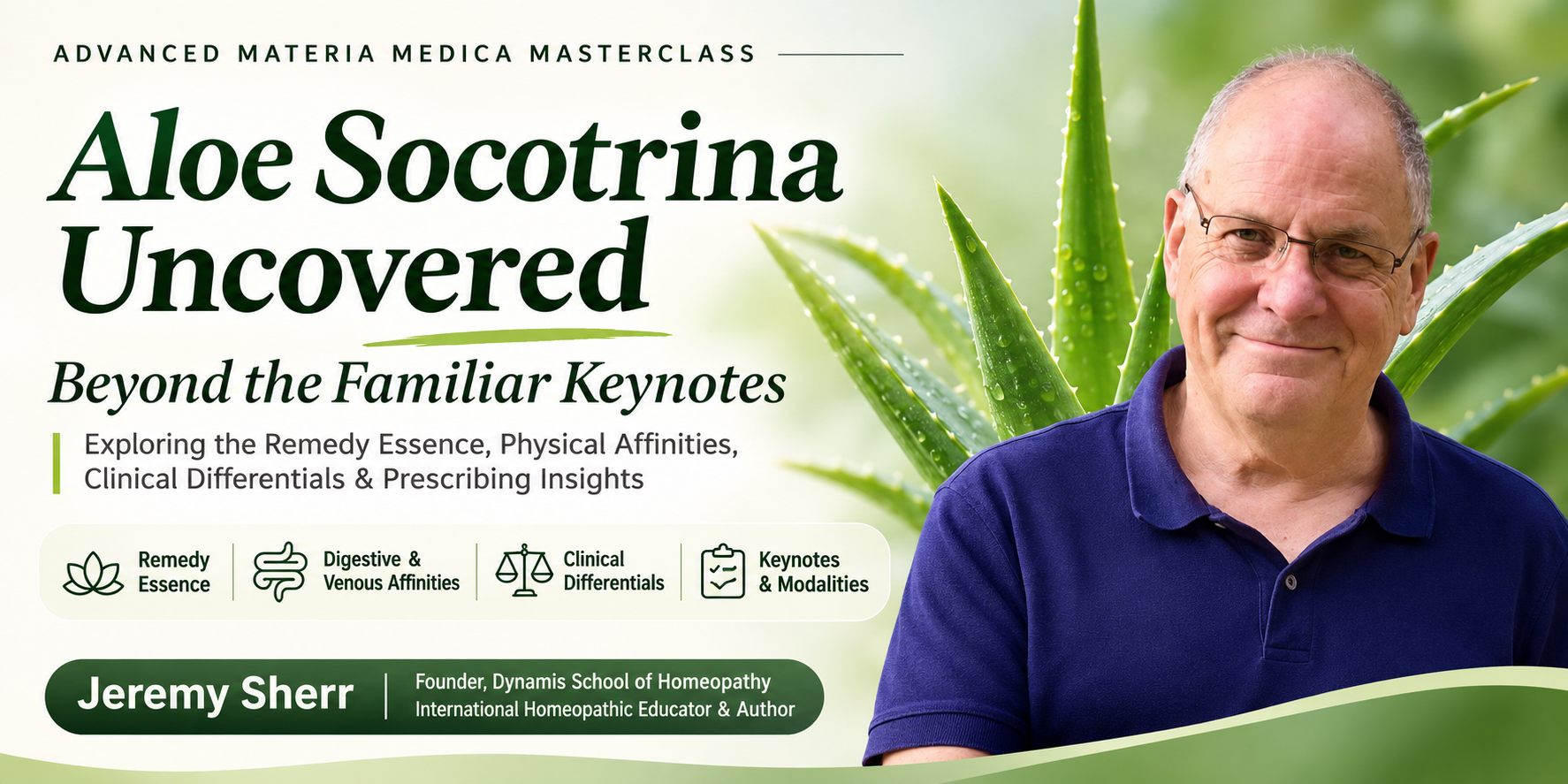
Discover the Deeper Remedy Picture of Aloe — From Its Core Essence and Venous Affinities to Characteristic Modalities and Clinical Differentiation
Instructor: Jeremy Sherr
Founder, Dynamis School of Homeopathy | International Homeopathic Educator, Author & Proving Researcher
Course Focus: Aloe socotrina Materia Medica | Remedy Essence | Digestive & Venous Affinities | Keynotes & Modalities | Differential Materia Medica
Is Your Understanding of Aloe Limited to Its Digestive Keynotes?
Most homeopaths know Aloe for its characteristic bowel symptoms, rectal complaints, and hemorrhoidal tendencies. But is that the complete remedy picture?
Behind these familiar indications lies a broader and more intricate Materia Medica profile—one that encompasses characteristic mental themes, portal and pelvic venous affinities, sphincter sensations, and distinctive modalities.
Yet, in everyday practice, Aloe socotrina is often remembered through a handful of physical keynotes rather than understood as a complete remedy.
What connects these apparently unrelated symptoms? How can we distinguish Aloe from remedies with similar physical indications? And what makes its characteristic pattern recognizable?
In this advanced recorded masterclass, Jeremy Sherr takes you beyond the conventional textbook description of Aloe socotrina to explore its deeper essence, physical affinities, characteristic symptoms, and clinical differentials.
Drawing upon decades of experience in homeopathic practice, teaching, and remedy provings, Jeremy brings his distinctive approach to understanding Materia Medica—connecting individual symptoms into a more coherent remedy picture.
Go beyond memorized keynotes. Discover the deeper dimensions of Aloe socotrina.
What You Will Learn
1. Discover the Core Essence of Aloe Socotrina
What lies beneath the familiar physical symptoms of Aloe?
Explore the remedy’s broader psychological and constitutional picture through Jeremy Sherr’s interpretation of Materia Medica.
-
Understand the underlying themes associated with the Aloe state.
-
Explore its characteristic mental and emotional expressions.
-
Examine alternating mental states and characteristic vulnerabilities.
-
Learn to connect mental symptoms with the broader physical remedy picture.
-
Develop a more integrated understanding of Aloe beyond isolated rubrics.
2. Understand Its Digestive, Rectal & Venous Affinities
Aloe has a distinctive place in classical homeopathic Materia Medica because of its traditional affinities for the digestive tract, rectum, and venous circulation.
Explore important areas of its physical symptom picture:
Digestive and Rectal Symptoms
-
Characteristic bowel urgency and rectal sensations.
-
The traditional keynote of diminished confidence in sphincter control.
-
Abdominal discomfort, distension, and characteristic bowel patterns.
-
Hemorrhoidal symptoms and rectal congestion.
Portal and Pelvic Venous Affinities
-
The classical picture of portal congestion.
-
Pelvic heaviness and sensations of fullness.
-
Venous tendencies and characteristic associated symptoms.
-
The relationship between local complaints and general modalities within homeopathic remedy analysis.
Learn how these symptoms are organized and interpreted within the traditional Aloe remedy picture.
3. Differentiate Aloe from Closely Related Remedies
When should Aloe be considered instead of Sulphur, Podophyllum, or another remedy with similar symptoms?
One of the most valuable aspects of advanced Materia Medica study is learning to recognize the differences between remedies that appear similar at first glance.
This masterclass explores the important clinical distinctions between Aloe and:
-
Sulphur: Overlapping rectal and digestive symptoms, with differences in the broader remedy picture.
-
Podophyllum: Characteristic bowel symptoms, urgency, and stool patterns.
-
Gambogia: Distinctive digestive symptoms and associated sensations.
-
Aesculus hippocastanum: Hemorrhoidal complaints, venous congestion, and rectal discomfort.
-
Thuja occidentalis: Differentiating broader constitutional and characteristic symptom patterns.
Discover how to compare remedies through their defining features rather than relying on one or two shared keynotes.
4. Recognize the Characteristic Keynotes & Modalities
Explore the details that make Aloe recognizable in classical Materia Medica.
-
Characteristic bowel and rectal sensations.
-
Sensations of heaviness, fullness, and weakness.
-
Distinctive physical generalities.
-
Aggravating and ameliorating factors.
-
The importance of concomitant symptoms.
-
How to evaluate characteristic symptoms within the totality of a case.
Learn how the relationship between keynotes, modalities, and general symptoms contributes to traditional remedy differentiation.
5. Learn from Jeremy Sherr’s Clinical Experience
Materia Medica becomes more memorable when individual symptoms are connected to a meaningful whole.
Through Jeremy Sherr’s teaching, explore:
-
How an experienced homeopath approaches a remedy beyond textbook descriptions.
-
The role of remedy provings in developing a Materia Medica picture.
-
Ways of identifying meaningful patterns among apparently disconnected symptoms.
-
The importance of observing the individual rather than prescribing on a diagnosis alone.
-
Practical insights and clinical observations from decades of homeopathic study.
Topics Covered in This Masterclass
Part 1: Understanding the Essence of Aloe
-
Introduction to the remedy.
-
Exploring its deeper themes.
-
Mental and emotional characteristics.
-
Connecting the remedy essence with its physical expressions.
Part 2: Physical Affinities and Characteristic Symptoms
-
Digestive and rectal symptoms.
-
Portal and pelvic venous patterns.
-
Sphincter-related sensations.
-
Physical generalities and modalities.
Part 3: Differential Materia Medica
-
Aloe versus Sulphur.
-
Aloe versus Podophyllum.
-
Aloe versus Gambogia.
-
Aloe versus Aesculus.
-
Aloe versus Thuja.
-
Identifying characteristic distinctions.
Part 4: Clinical Understanding and Integration
-
Recognizing the complete remedy picture.
-
Evaluating keynotes and concomitants.
-
Integrating mental and physical symptoms.
-
Clinical observations and insights from Jeremy Sherr.
Meet Your Instructor — Jeremy Sherr
Jeremy Sherr is an internationally recognized homeopathic practitioner, author, educator, and researcher whose work has influenced the study and teaching of contemporary homeopathic Materia Medica.
He is the founder of the Dynamis School of Homeopathy and has spent decades teaching homeopaths across the world.
His contributions include:
Remedy Provings and Materia Medica
Jeremy has conducted numerous homeopathic remedy provings, contributing to the expansion and interpretation of contemporary homeopathic Materia Medica.
International Homeopathic Education
Through the Dynamis School and his international seminars, he has taught generations of students and practitioners, encouraging a deeper, more systematic understanding of remedies.
Clinical Experience
His teaching draws upon decades of homeopathic practice and observation, combining classical principles with his own approach to understanding remedy patterns.
Authorship and Research
Jeremy has authored influential works on homeopathic provings and Materia Medica and is widely known within the international homeopathic community for his distinctive teaching style.
In this masterclass, he brings that depth of experience to Aloe socotrina, exploring the remedy beyond its most commonly memorized indications.
Who Should Enroll?
Practicing Homeopaths
For clinicians who want to develop a more comprehensive understanding of Aloe and its characteristic symptom picture.
Homeopathy Students and Postgraduates
For students seeking to move beyond memorizing keynotes and develop a more integrated approach to Materia Medica.
Homeopathic Educators
For teachers interested in exploring remedy essence, physical affinities, and differential analysis through Jeremy Sherr’s approach.
Experienced Practitioners
For homeopaths who enjoy advanced remedy study and want to revisit familiar remedies from a different perspective.
Why Study Aloe with Jeremy Sherr?
Aloe is often introduced as a remedy for digestive and rectal complaints.
But a deeper study of Materia Medica asks more interesting questions:
What connects its characteristic symptoms? How do its physical affinities relate to its broader remedy picture? What distinguishes it from remedies with similar indications?
Jeremy Sherr’s approach encourages students to explore these connections rather than study symptoms in isolation.
One remedy. Multiple dimensions. A deeper understanding of Materia Medica.
Enroll Now — Explore Aloe Socotrina with Jeremy Sherr
Revisit a familiar remedy through the perspective of one of homeopathy’s internationally recognized educators.
Get Instant Access to the Recorded Masterclass
What’s Included with Your Enrollment?
-
Full Recorded Masterclass: Watch Jeremy Sherr’s complete lecture at your own pace. Two years access.
-
On-Demand Learning: Revisit important concepts, keynotes, and remedy comparisons whenever needed.
Part of Remedy Roundtable 2025
This lecture was originally presented as part of Remedy Roundtable 2025, an advanced Materia Medica learning program featuring international homeopathic educators.
Want to explore more remedies and learn from different approaches to Materia Medica?
Course Content
Recorded lecture
-
Recorded lecture
00:00
Get a certificate
Participants who complete the programme will receive a downloadable certificate of participation from Hpathy.
Student Ratings & Reviews
