
About Course
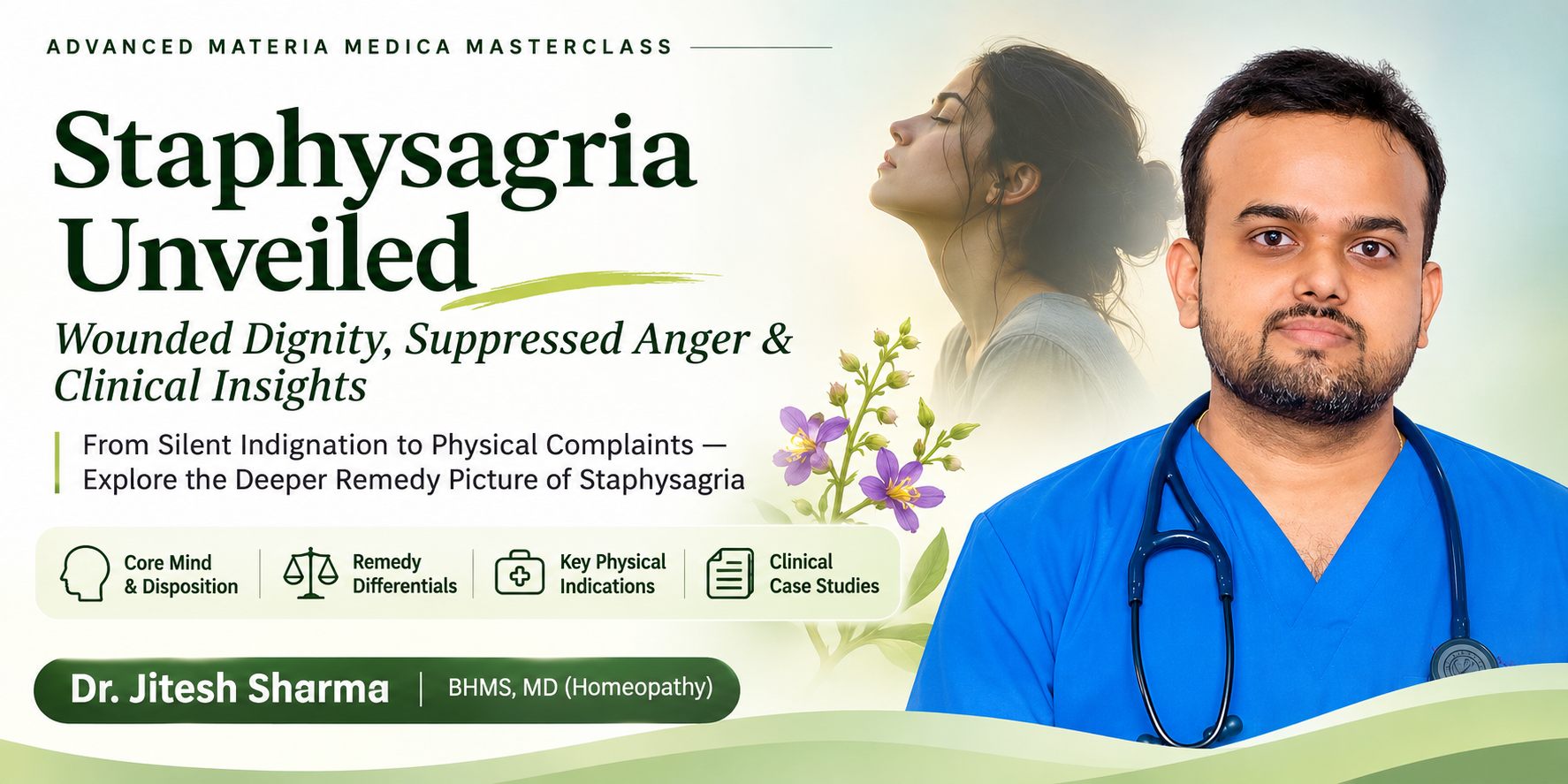
From Silent Indignation to Physical Complaints — Explore the Deeper Remedy Picture of Staphysagria
Instructor: Dr. Jitesh Sharma, BHMS, MD (Homeopathy)
Founder, JDS Homeopathic Hospital | Author & Clinical Homeopathy Educator
Course Focus: Staphysagria Materia Medica | Suppressed Anger | Indignation | Remedy Differentiation | Clinical Case Analysis
When Anger Remains Unspoken: Understanding the Staphysagria State
What happens when someone is deeply hurt, humiliated, or insulted—but cannot express their anger?
Consider the person who silently tolerates injustice, the individual who feels deeply wounded by criticism, or someone who struggles to defend their dignity despite intense inner resentment.
Within classical homeopathic Materia Medica, these experiences form part of the characteristic emotional picture traditionally associated with Staphysagria.
But Staphysagria is much more than a remedy associated with suppressed anger.
Its traditional Materia Medica also includes a distinctive range of physical indications—from recurrent styes and urinary complaints to incised wounds and postoperative discomfort.
How do we bring these apparently unrelated symptoms together into a meaningful remedy picture?
In this advanced clinical masterclass, Dr. Jitesh Sharma explores Staphysagria through its emotional themes, characteristic physical symptoms, differential diagnosis, and detailed clinical cases.
Drawing upon his clinical experience and classical homeopathic training, Dr. Sharma demonstrates how he interprets patient histories, recognizes characteristic patterns, and integrates mental and physical symptoms into homeopathic case analysis.
Go beyond memorizing keynotes. Explore the deeper dynamics of Staphysagria and the clinical reasoning behind remedy selection.
What You Will Learn
1. Understand the Core Mind State of Staphysagria
Explore the emotional and psychological characteristics traditionally associated with Staphysagria:
-
Silent indignation: Deep resentment following insults, injustice, or perceived humiliation.
-
Suppressed anger: Intense emotional reactions that remain unexpressed.
-
Wounded dignity: Heightened sensitivity to disrespect, criticism, and personal humiliation.
-
Reservedness and restraint: Difficulty confronting others or expressing genuine feelings.
-
Emotional sensitivity: The tendency to feel deeply hurt by seemingly minor remarks or experiences.
-
Anger versus submission: The contrast between outward politeness and inner emotional turmoil.
Learn to recognize the broader Staphysagria remedy picture rather than relying on a single emotional keynote.
2. Explore the Relationship Between Emotional Experiences and Physical Symptoms
One of the distinctive aspects of Staphysagria Materia Medica is its traditional association with ailments following indignation, humiliation, and suppressed emotions.
Dr. Sharma explores how homeopaths interpret:
-
The significance of insult, humiliation, and wounded self-respect.
-
Emotional restraint and unresolved interpersonal conflicts.
-
Experiences of rejection, betrayal, and broken relationships.
-
The patient’s subjective experience of emotional trauma.
-
The relationship between causation, characteristic symptoms, and remedy selection.
Discover how emotional histories are incorporated into traditional homeopathic case analysis without losing sight of the patient’s physical symptoms and medical diagnosis.
3. Recognize the Characteristic Physical Indications of Staphysagria
Study the important physical symptoms and clinical presentations described in classical Materia Medica.
Wounds and Surgical Complaints
-
Traditional indications involving incised wounds.
-
Postoperative discomfort and sensitivity.
-
Wound-related symptoms and characteristic modalities.
-
The distinction between a homeopathic remedy indication and the medical management of a wound.
Urinary and Genitourinary Complaints
-
The classical Staphysagria picture in cystitis-like symptoms.
-
Urinary discomfort associated with sexual activity, traditionally described as honeymoon cystitis.
-
Characteristic urinary sensations and modalities.
-
The importance of differentiating remedy symptoms from underlying medical conditions.
Eye Complaints
-
Recurrent styes and eyelid inflammation.
-
Characteristic local symptoms.
-
The relevance of associated general and constitutional features.
Other Physical Manifestations
-
Pain sensitivity and characteristic sensations.
-
Complaints associated with injury or trauma.
-
Physical generalities and modalities.
-
The integration of local symptoms with the broader remedy picture.
4. Differentiate Staphysagria from Similar Remedies
When does suppressed anger point toward Staphysagria—and when should another remedy be considered?
Explore the importance of distinguishing between remedies that share similar emotional themes.
Staphysagria vs. Nux vomica
-
Suppressed indignation versus more openly expressed irritability.
-
Different patterns of anger, sensitivity, and emotional response.
-
The significance of physical generalities and accompanying symptoms.
Staphysagria vs. Ignatia
-
Indignation and wounded dignity versus the characteristic grief-related patterns of Ignatia.
-
Emotional suppression and sensitivity.
-
The importance of causation and characteristic concomitants.
Learn how to move beyond common mental rubrics and evaluate the complete symptom picture in homeopathic remedy differentiation.
5. Learn Through Detailed Clinical Cases
Explore the application of Staphysagria Materia Medica through two distinctive cases presented by Dr. Sharma.
Case Study 1: Traumatic Breast Pain and Broken Relationships
A case exploring the intersection of physical pain, emotional experiences, and relationship difficulties.
Key learning areas:
-
Understanding the patient’s personal and emotional history.
-
Exploring the significance of broken relationships.
-
Analyzing the physical complaint and associated symptoms.
-
Identifying characteristic features relevant to Staphysagria.
-
Following the lecturer’s clinical reasoning.
Case Study 2: Spinal Arachnoid Cyst and a History of Childhood Abuse
A complex case examining how a history of childhood trauma was considered within a broader homeopathic assessment.
Key learning areas:
-
Approaching sensitive personal histories with care.
-
Understanding the patient’s emotional responses and coping patterns.
-
Examining the neurological diagnosis and associated symptoms.
-
Exploring the lecturer’s interpretation of the Staphysagria picture.
-
Understanding the distinction between case interpretation and established medical causation.
These cases provide an opportunity to study the lecturer’s reasoning in presentations that extend beyond routine keynote-based prescribing.
Topics Covered in This Lecture
Part 1: The Essence of Staphysagria
-
Introduction to the remedy and its traditional Materia Medica.
-
The central themes of dignity, indignation, and emotional suppression.
-
Reservedness, sensitivity, and inner resentment.
-
Recognizing the characteristic mental picture.
Part 2: Emotional Causation and the Patient’s Life Story
-
Experiences of insult, humiliation, and injustice.
-
Broken relationships and emotional restraint.
-
The significance of past experiences in homeopathic case-taking.
-
Integrating mental and physical symptoms.
Part 3: Physical Symptoms and Clinical Indications
-
Incised wounds and postoperative complaints.
-
Recurrent styes and eye symptoms.
-
Cystitis-like complaints and urinary symptoms.
-
Physical modalities, sensations, and concomitants.
Part 4: Differential Materia Medica
-
Staphysagria versus Nux vomica.
-
Staphysagria versus Ignatia.
-
Distinguishing characteristic emotional patterns.
-
Using the complete remedy picture for differentiation.
Part 5: Clinical Case Discussions
-
Traumatic breast pain and relationship difficulties.
-
Spinal arachnoid cyst and childhood trauma history.
-
Understanding the lecturer’s analysis and remedy rationale.
-
Lessons for future Materia Medica study.
Meet Your Instructor — Dr. Jitesh Sharma
Dr. Jitesh Sharma, BHMS, MD (Homeopathy), is a homeopathic clinician, academician, author, and founder of JDS Homeopathic Hospital in Odisha.
His professional journey combines classical homeopathic education, mentorship under experienced practitioners, and extensive clinical work.
International Education
Dr. Sharma has trained at the International Academy of Classical Homeopathy (IACH), Greece, under Prof. George Vithoulkas.
Mentorship and Clinical Learning
His homeopathic education has also been influenced by prominent teachers and practitioners, including:
-
Dr. Rajan Sankaran
-
Dr. Mahesh Gandhi
-
Dr. Devendra Shah
-
Dr. Pradeep Gupta
-
Dr. Farokh Master
Founder — JDS Homeopathic Hospital
Dr. Sharma established JDS Homeopathic Hospital, described as Odisha’s first private homeopathic hospital, incorporating diagnostic, pathology, and rehabilitation facilities.
Author
He is the author of My Journey through Homeopathic Materia Medica, reflecting his interest in the clinical understanding and teaching of homeopathic remedies.
Through this masterclass, Dr. Sharma shares his interpretation of Staphysagria, drawing upon classical Materia Medica and his clinical experiences.
Who Should Enroll?
Practicing Homeopaths
For clinicians who want to explore Staphysagria beyond familiar keynotes and study its broader mental and physical remedy picture.
Postgraduate Students and Interns
For students seeking a deeper understanding of emotional causation, differential Materia Medica, and case analysis.
Homeopathic Educators
For teachers interested in using clinical examples to explain the relationship between characteristic symptoms and remedy themes.
Experienced Clinicians
For practitioners who want to examine complex cases involving emotional histories, physical pathology, and individualized homeopathic assessment.
Why Study Staphysagria with Dr. Jitesh Sharma?
Many students remember Staphysagria as the remedy of suppressed anger and indignation.
But recognizing a keynote is only the beginning of understanding a remedy.
The greater challenge is exploring how emotional sensitivity, wounded dignity, personal history, physical symptoms, and modalities are brought together in homeopathic Materia Medica.
This lecture offers an opportunity to study those connections through the perspective of an experienced clinician.
Understand the mind. Recognize the characteristic symptoms. Explore the cases. Deepen your Materia Medica knowledge.
Enroll Now — Explore Staphysagria with Dr. Jitesh Sharma
Gain access to this advanced Materia Medica lecture and explore one of classical homeopathy’s most distinctive remedy pictures.
Part of Remedy Roundtable 2025
This lecture was originally presented as part of Remedy Roundtable 2025, an advanced Materia Medica program featuring homeopathic educators and clinicians.
Interested in exploring more remedies through different clinical approaches?
Course Content
Recorded lecture
-
Recorded lecture
00:00
Get a certificate
Participants who complete the programme will receive a downloadable certificate of participation from Hpathy.

Student Ratings & Reviews
