
Master the Art of Case Taking Through the Organon
About Course
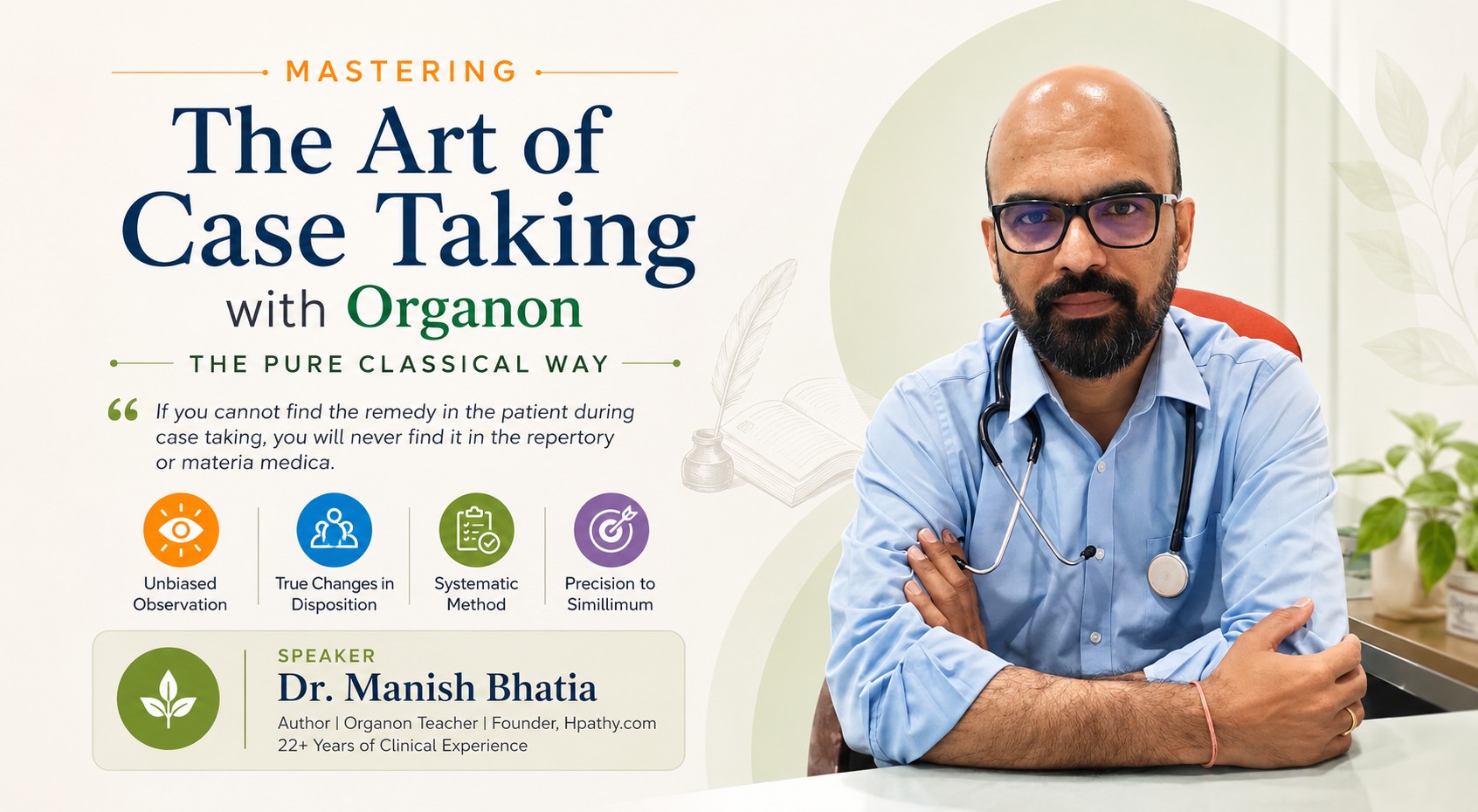
The Pure Classical Method for Seeing the Patient Clearly and Reaching the Simillimum
Teacher: Dr. Manish Bhatia
“If you cannot find the remedy in the patient during case taking, you will never find it in the repertory or Materia Medica.”
A successful prescription does not begin with repertorization.
It begins much earlier—in the way you observe, listen, question and understand the patient.
Yet many homeopaths study the Organon of Medicine primarily as a collection of aphorisms for examinations. When they enter clinical practice, they fall back on rigid case-taking forms, long symptom checklists and repetitive questioning.
The result is often a case filled with information—but lacking the information that actually matters.
In this practical masterclass, Dr. Manish Bhatia brings the case-taking principles of the Organon out of the textbook and into the consulting room. You will learn how to conduct a focused, unbiased and clinically meaningful interview that reveals the patient’s true disease state and provides reliable material for prescription.
Why Good Case Taking Is So Difficult
A patient may speak for an hour and still leave you without a clear remedy picture.
You may collect dozens of symptoms, but remain uncertain about which ones are characteristic.
You may mistake a lifelong personality trait for a recent change caused by disease.
You may unconsciously guide the patient toward the answer you expect.
And when this confused information is entered into the repertory, even the best software cannot rescue the case.
This course teaches you how to prevent those errors at their source.
What You Will Learn
Become an Unprejudiced Observer
Understand the practical meaning of Hahnemann’s instructions in Aphorisms 83–104.
Learn how to observe without interpreting too early, listen without imposing your theories and ask questions without suggesting the answer.
You will discover how to use open-ended, non-leading questions that allow the patient’s individual state to emerge naturally.
Separate the Patient’s Personality From the Disease State
One of the most common prescribing errors is selecting a remedy for who the patient has always been rather than identifying what has changed since illness began.
You will learn how to:
- Establish the patient’s healthy baseline
- Identify genuine changes in disposition
- Distinguish constitutional traits from disease-related symptoms
- Trace the sequence of mental, emotional and physical changes
- Recognize what is truly characteristic in the present case
Identify the Real Cause Behind the Case
Not every stressful event is an etiology, and not every symptom that follows an event is causally connected to it.
Learn how to investigate:
- Exciting causes in acute disease
- Maintaining causes that obstruct recovery
- Fundamental causes in chronic cases
- The timeline between an event and the onset of illness
- The difference between meaningful causation and coincidence
This helps you avoid forcing an attractive but inaccurate “ailments from” rubric into the case.
Apply the GIGO Principle to Repertorization
Garbage in, garbage out.
A repertory can only work with the symptoms you select. Poorly observed, vaguely expressed or incorrectly interpreted symptoms produce unreliable results.
Dr. Bhatia will show you how to:
- Filter irrelevant information
- Reject common and non-characteristic symptoms
- Avoid converting every patient statement into a rubric
- Preserve the patient’s exact meaning
- Select dependable symptoms with prescribing value
- Build a clean, coherent totality
The objective is not to collect more symptoms. It is to identify better symptoms.
Ask Questions Without Distorting the Case
Every question influences the interview.
Learn how to move from broad narration to precise clarification without interrogating the patient or contaminating the response.
You will understand:
- When to remain silent
- When to interrupt
- When to clarify
- When to return to an earlier statement
- How to explore an unusual expression
- How to recognize rehearsed, intellectualized or socially acceptable answers
Balance Empathy With Clinical Objectivity
A patient must feel heard, but the physician must also remain clear.
This course explores how to create a safe, trusting consultation without becoming emotionally overwhelmed, overinvolved or distracted from the clinical purpose of the interview.
You will learn how to maintain compassionate presence while preserving the distance required for accurate observation and analysis.
Watch the Method Applied to a Live Case
The course moves beyond theory through a complete case-taking demonstration.
Watch Dr. Bhatia conduct an unedited clinical interview and observe:
- How he begins the consultation
- How he allows the patient to narrate freely
- Which statements he chooses to explore
- Which details he deliberately leaves aside
- How he identifies changes in disposition
- How he investigates causation and chronology
- How raw patient language is converted into useful symptoms
- How the final totality begins to reveal the simillimum
You will not merely hear what questions to ask. You will see why a particular question is asked at a particular moment.
Who Should Attend?
This masterclass is designed for:
Homeopathic students who understand theory but feel uncertain during real patient interviews.
New practitioners who struggle with long, confusing cases and excessive symptom collection.
Experienced homeopaths who want to refine their interviewing, observation and symptom-selection skills.
Organon teachers and postgraduate learners seeking a practical demonstration of Hahnemannian case-taking principles.
Practitioners using any repertorial or Materia Medica approach, because every prescribing method depends on the quality of the case taken.
About the Speaker
Dr. Manish Bhatia
Dr. Manish Bhatia is a homeopathic physician, author and teacher with more than two decades of clinical and teaching experience.
He is the author of the widely studied Lectures on Organon of Medicine series and the founder of Hpathy.com, one of the world’s largest professional homeopathy platforms.
Known for making complex homeopathic philosophy clear, practical and clinically relevant, Dr. Bhatia teaches the Organon not as historical theory, but as a precise system for understanding the patient and improving the reliability of every prescription.
The Repertory Cannot Correct a Poorly Taken Case
No advanced method, software or Materia Medica system can compensate for inaccurate observation and unreliable symptoms.
The ability to see what is characteristic—and ignore what is not—is the foundation of classical homeopathic practice.
Stop collecting symptoms mechanically.
Start understanding the patient systematically.
Learn to take the case in a way that allows the remedy to reveal itself.
The video lectures in this course are part of the course ‘Master Case Taking with Masters’. Link to the course is Master Case Taking With The Masters – Hpathy Global Academy
Course Content
Organon of Medicine as a fundamental guide to case taking
-
Organon of Medicine as a fundamental guide to case taking
00:00
QnA from Session 1 and Case Studies
Live Case Taking and solving
Get a certificate
Participants who complete the programme will receive a downloadable certificate of participation from Hpathy.
Student Ratings & Reviews